


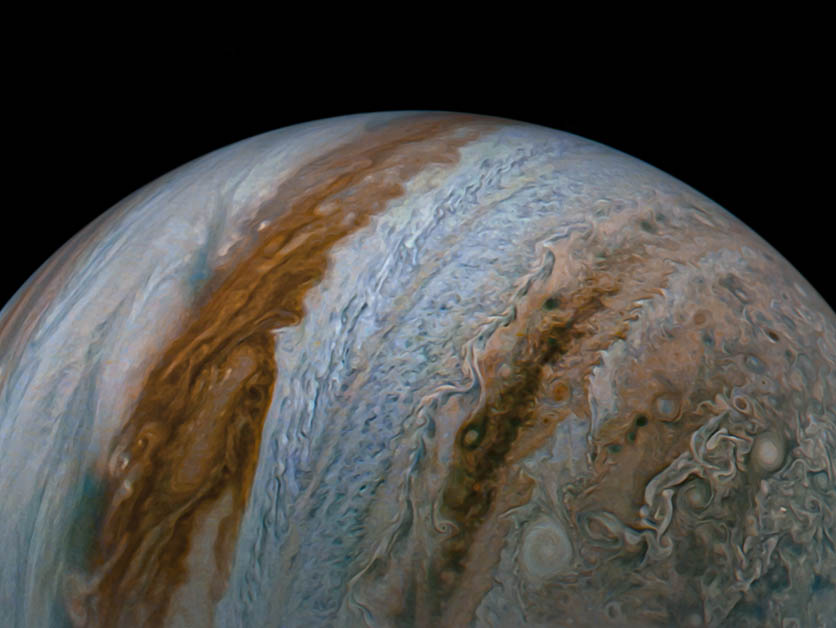
Blasting around the equators of the solar system鈥檚 giant planets 鈥� Jupiter, Saturn, Uranus and Neptune 鈥� are fierce jet streams reaching speeds of 500 to 1,500 kilometers per hour. For years, scientists have puzzled over why these extreme winds blow eastward on Jupiter and Saturn but westward on Uranus and Neptune, even though the four planets share similar conditions: All receive little sunlight, possess a moderate internal heating source and rotate rapidly. Now, researchers at the Weizmann Institute of Science have developed a new model that, for the first time, offers a single mechanism explaining this long-standing mystery. Their findings were in Science Advances.

The study, led by Dr. Keren Duer-Milner as part of her PhD studies in in Weizmann鈥檚 Earth and Planetary Sciences Department, used hydrodynamic modeling to show that variations in atmospheric depth can account for the opposite wind directions. In other words, under the same physical conditions, a planet鈥檚 jet streams can flow either eastward or westward depending on how deep its atmosphere extends.
鈥淲e were excited to find a simple and elegant explanation for such a complex phenomenon,鈥� says Duer-Milner, now a postdoctoral fellow at Leiden University in the Netherlands. 鈥淯nderstanding these jet streams reveals fundamental processes that shape atmospheric dynamics 鈥� not only in our solar system but across our galaxy. This insight gives us a new tool for exploring the enormous climatic diversity throughout the universe.鈥�
