


RNA technology is regarded as one of the newest frontiers in medicine, but in fact a primordial innovator got there way before we did. The malaria parasite, an ancient single-celled organism, has been using sophisticated RNA maneuvers for millennia. In a study , researchers at the Weizmann Institute of Science uncover the parasite鈥檚 RNA strategies 鈥� mechanisms that could inspire unexpected applications for RNA-based tools in multiple areas of medicine.
More than a decade ago, Prof. discovered that the malaria parasite Plasmodium falciparum, which invades human red blood cells, sends out tiny vesicles to communicate with fellow parasites inside other red blood cells. These nanovesicles 鈥� wrapped, sac-like packages addressed to other cells 鈥� were shown to transfer pieces of DNA from one parasite to another. But Regev-Rudzki and her team found that the vesicles also contain other molecular cargo, including various types of RNA.

The researchers reasoned that the clever parasite wouldn鈥檛 transport its RNAs via vesicles without good reason. In the new study, the team, in Weizmann鈥檚 Biomolecular Sciences Department, set out to determine whether the vesicles enable the RNAs to perform tasks beyond messaging. Because the team had previously shown that nanovesicles enter not only red blood cells but also immune cells called monocytes, the researchers suspected the parasite might be trying to mess with the host鈥檚 immune defenses.
They soon learned that the parasite is even more devious than they had imagined. The team, led by Dr. Paula Abou Karam, then a PhD student, found that the RNAs in the vesicles were not random fragments but rather messenger RNA, or mRNA 鈥� specifically, molecules containing instructions for producing one of the parasite鈥檚 most abundant protein families. Could the parasites be inserting their own mRNA into the cells鈥� protein-making machinery in the cytoplasm?
“”This seemed incredible. The cell guards its nucleus jealously because it houses the cell鈥檚 鈥榖rain鈥�”
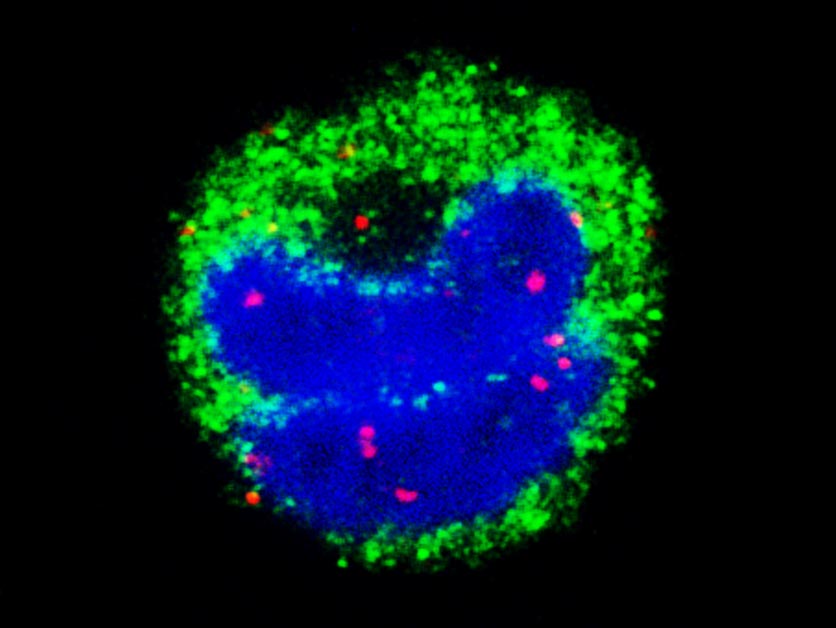
Contrary to expectations, there was no sign of the parasitic proteins they expected these RNAs to make in the cytoplasm of the monocytes. Instead, to the researchers鈥� surprise, the RNAs appeared to be entering the immune cells鈥� highly protected nuclei.
鈥淭his seemed incredible,鈥� Regev-Rudzki recalls. 鈥淭he cell guards its nucleus jealously because it houses the cell鈥檚 鈥榖rain.鈥� To convince ourselves 鈥� and others 鈥� that the parasite鈥檚 RNAs truly penetrate these defenses, we had to observe them directly inside the nucleus.鈥�
At first, this task seemed nearly impossible. Parasitic RNA molecules are present in extremely small amounts that are easily lost within the crowded nucleus. Another difficulty stemmed from the parasite鈥檚 genome itself, which is unusually repetitive, composed largely of just two genetic letters, A and T. Designing a method sensitive enough to detect the parasite鈥檚 RNAs amid all the host genetic material was thus a huge challenge.

鈥淪ometimes what makes or breaks a research project is the student who leads it, and this was one of those classic cases,鈥� Regev-Rudzki says. 鈥淧aula took on the challenge, keeping at it for a year and a half until she ultimately succeeded.鈥�
Abou Karam developed a fluorescent probe that caused minuscule red dots to light up inside the monocyte nucleus. Each dot represented a single malarial mRNA molecule that had breached the nuclear barrier.
The next question was: What were these RNAs doing there? The researchers discovered that once inside the nucleus, the parasite mRNA binds to two human proteins, ACIN1 and PNN 鈥� key components of the cellular splicing machinery. Like splicing film, cells use the splicing to edit RNA transcripts, cutting and rearranging segments before allowing them to be translated into proteins. It serves as a crucial quality-control step: Without proper splicing, RNAs do not 鈥渕ake sense,鈥� and they are generally discarded before they can be translated into proteins.
At this stage, the researchers joined forces with the team of Dr. of the Hebrew University of Jerusalem, an expert in splicing and RNA. Together, they revealed splicing manipulation in recipient monocytes, thereby deciphering the parasite鈥檚 RNA strategy.
Sabotage in the nucleus
In effect, the parasite jams the internal communications of the host鈥檚 immune system. By getting its mRNA into monocyte nuclei, it disrupts the host cell鈥檚 own RNA processing. The result is chaos. Critical immune transcripts 鈥� meant to produce proteins that fight infection 鈥� are improperly spliced and then sent off to be degraded. As a result, the production of entire families of immune proteins is shut down.
As they continued to observe the immune cell takeover, the scientists found that the manipulated monocytes send out distress signals, triggering a wave of immune activation that mobilizes additional immune cells. But while these cells rush to deal with the apparent crisis inside the monocytes, the real threat 鈥� parasites quietly multiplying inside red blood cells 鈥� escapes attention.
鈥淚t鈥檚 a decoy mechanism,鈥� Regev-Rudzki says. 鈥淟ike throwing a grenade in one direction so the guards run toward it, while you move somewhere else.鈥� By confusing immune cells and suppressing key defense proteins, the parasite buys itself precious time to grow and spread.
These findings point to a potential new target for antimalarial drugs 鈥� therapies designed to prevent malarial RNAs from tampering with the host鈥檚 splicing machinery.
The work may also open new avenues for diagnosis, not only of malaria but of other infectious diseases. Bilharzia parasites, for example, can reside in the gut for years, causing damage while remaining undetectable in standard blood tests. Regev-Rudzki believes that they, and other parasites, may be releasing vesicles whose RNA signatures in the bloodstream might reveal their presence.
The study鈥檚 implications extend far beyond infectious disease. Vesicles abound in the body, and searching for their cargo not only in the cytoplasm but in unexpected places such as the carefully guarded nuclei, can increase the chances of intercepting these packages and reading their messenger RNA. And that, in turn, might help us decipher disease-promoting mechanisms. The feints and strategies employed by cancer, for example, include the release of vesicles that influence surrounding healthy tissue. Vesicles are also an active area of research in Parkinson鈥檚, ALS and other neurodegenerative diseases. Vesicle-bound RNAs circulating in blood may one day serve as early biomarkers for these disorders.
Science Numbers
Malaria kills a child every 60 seconds.
Also participating in the study were Edo Kiper, Shaked Yadid, Dr. Ewa Kozela, Nir Zharoni, Dr. Reinat Nevo, Daniel Alfandari, Helina Otesh, Abel Cruz Camacho and Dr. Ofer Shoshani of Weizmann鈥檚 Biomolecular Sciences Department; Dr. Tamar Ziv of the Technion 鈥� Israel Institute of Technology; Dr. Yoav Lubelsky and Prof. Igor Ulitsky of Weizmann鈥檚 Immunology and Regenerative Biology Department; Drs. Ron Rotkopf, Ekaterina Petrovich-Kopitman and Ziv Porat of Weizmann鈥檚 Life Sciences Core Facilities Department; Dr. Eviatar Weizman of the Nancy and Stephen Grand Israel National Center for Personalized Medicine; Moshe Cossin of the Hebrew University of Jerusalem; Dr. Irit Rosenhek-Goldian of Weizmann鈥檚 Chemical Research Support Department; and Prof. Carmit Levy of Tel Aviv University.
Prof. Neta Regev-Rudzki鈥檚 research is supported by the Henry Chanoch Krenter Institute for Biomedical Imaging and Genomics; the Dr. Barry Sherman Institute for Medicinal Chemistry; the Kleinman Cancer Cell Sorting Facility; the Henri Gutwirth Award; the Karen Siem Fellowship for Women in Science; and the Brenden-Mann Women鈥檚 Innovation Impact Fund.